
Phone Protection Film Vending Carts: A Lean Retail Format for Screen-Protection Brands
Screen protection is a high-margin add-on sold in the moment. The format that sells it best is rarely a shop — it is a branded cart with a working counter, an application area and panels that behave like a billboard.
The problem with selling film from a fixed counter
Screen protection is bought on impulse, and almost always within sight of the phone. The customer has just bought a handset, or dropped one, or seen a cracked screen on someone else's. A film counter tucked inside a phone shop only reaches the people who already walked into that shop.
A cart changes the geography. It can stand in the mall corridor between the phone shops, on the forecourt outside, or in front of a cosmetics store whose customers are the same people. The same staff, the same stock, a different catchment.
What the DT01 is built to do
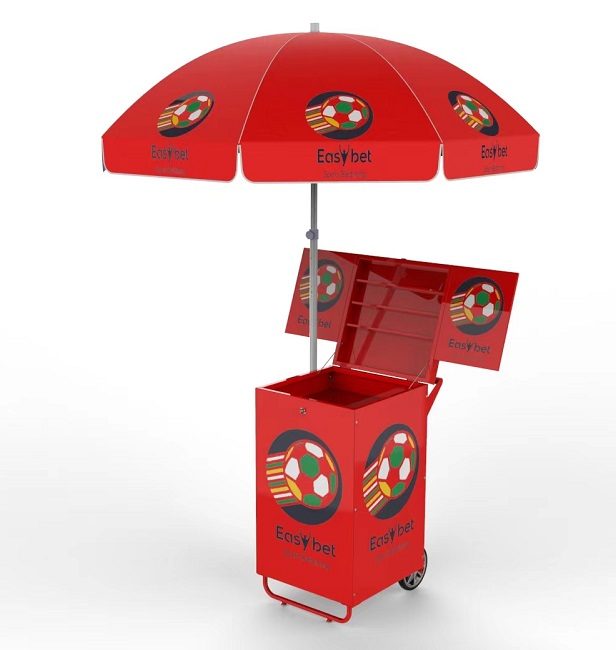
DT01 is a branding phone protection film vending cart, specified for high-quality film marketing activities and for setting up agent points of sale. Its design brief is unusually clear, and it is worth reading as a checklist rather than a specification sheet:
- Visibility. A large advertising area on the front and on the sides, so the cart reads as brand communication before it reads as furniture.
- Durability. Sheet metal body with a colour-stable powder coating — the finish has to survive sun, dust and daily handling without fading into a different shade than the brand guide.
- Mobility. Four wheels at the base, so one person can reposition the cart along the street or across a mall floor.
- Weather control. A fabric canopy that opens for sun protection during trade and folds away when the unit is closed.
Four ways operators actually use it
The cart is not only a sales point. In practice we see four distinct jobs assigned to the same unit:
- Market testing a new film. A brand that wants to test a new grade or a new price point rents a batch of carts — or buys them — and runs a short campaign instead of fitting out a shop.
- Increasing footfall capture. Placed inside a mall or on the square outside it, the cart intercepts traffic that was never going to enter a store.
- Filling an organised retail zone. Mall operators assemble branded mini-shops in a corridor or atrium and need units that look designed for the space rather than improvised.
- Attracting attention in front of a shop. A single cart outside a storefront extends the shop's reach by a few metres, which is often exactly the few metres that matter.
A cart an agent can actually run
Most screen-protection brands in emerging markets work through agents rather than through owned stores. A cart is the cheapest credible unit an agent can be given: it can be delivered, branded and trading within days, and it can be taken back if the agent underperforms.
That changes what the unit has to be. It needs to be standard enough that a hundred agents produce the same impression, and modular enough that a damaged panel is replaced rather than rebuilt. It also needs a specification an agent can be trained on in an afternoon — where the stock sits, where the film is applied, what the customer sees first.
The same logic applies to a brand running its own network: the unit is not a one-off build, it is a template. Anything that has to be adjusted site by site — a wider counter here, a taller canopy there — should be a documented option, not a fresh negotiation with the factory each time.
What to decide before the artwork is drawn
The order of decisions matters: artwork drawn before the site is chosen usually gets redrawn. Settle these first.
- Which two or three surfaces carry the brand, and which carry price or product information?
- Does the operator work standing or seated, and how much clear counter space does the film application need?
- Where does stock live during the shift, and can it be locked away at night?
- Is the site powered? Lighting and any screen change the specification.
- How does the cart enter the building — service lift, ramp, standard door width?
Where the format stops making sense
A cart earns its keep in high-traffic, short-dwell locations where the offer is understood in seconds. It is the wrong tool for destinations that require consultation, for sites without secure overnight storage, and for locations where the unit must stay in one place for years — there, a fixed kiosk or a shop-in-shop will cost less over time.
The honest test is arithmetic: compare the monthly cost of rent, fit-out and staff in a fixed unit against the purchase price of a cart and the cost of moving it between sites. When the campaign is short, the cart wins by a wide margin.
Specifying a cart for a film or accessories brand?
Tell us the site — mall corridor, street, forecourt or shop front — and how the operator works. We will propose the format and the surfaces that carry your branding.
Or email market@flowvisual.com. We reply within 24 hours on business days.