The Third Retail Channel: What a Branded Pop-Up Shop Is For
A brand has two conventional ways to reach a customer: a fixed shop and an online store. The branded pop-up is the third — and it is judged by different economics.
Three ways to be present
A fixed shop buys permanence: it carries rent, renovation and staff, and it earns the right to be found on the same street for years. An online store buys reach: it carries warehousing, logistics and media spend, and it can serve a country from one building.
The branded pop-up buys something else: presence where the customer already is, for as long as it is worth paying for. It is not a cheaper shop and it is not a physical website. It is a third format with its own economics — and the brands that use it well treat it as a channel, not as a stunt.
The brief we design against, in nine lines
Our own design philosophy is short enough to use as a checklist when a brand asks what a pop-up should be. Three lines describe the scene, three describe the format, three describe the economics:
- New scene, new media, new appearance. The unit has to look like it belongs in the place it stands — a mall corridor, a forecourt, a market — and it has to carry media, not just merchandise.
- Portable shop, pop-up shop, shop-in-shop. One product family should cover a standalone unit, a temporary activation and a branded island inside a partner's store.
- Save rent, save renovation, save transport. The commercial case rests on what the unit replaces every month, not on its purchase price alone.
- Quick to start, quick to close, quick to move. If opening takes a week and closing takes a truck and four people, the format has failed its own purpose.
Three values that decide whether it survives the site
Portability is easy to claim and hard to deliver. In practice three qualities decide whether a unit is still usable in its second year:
- Beauty. The unit is a piece of brand communication standing in public. Its proportions, finish and print quality are read as statements about the brand, whether or not anyone intended them to be.
- Innovation in the details. A folding mechanism that one person can operate, a counter that locks, a cable route that does not become a trip hazard — the innovation that matters is operational, not decorative.
- Convenience and durability. Collapsible structures lower transport cost, but only if the hinges, latches and panels survive daily use. Materials chosen to last are also the ones that do not become waste in eighteen months.
Customisation is the product
A pop-up that looks like a generic cart is a cart. What makes it a channel is that the colour, the dimensions, the logo application and the advertising graphics are specified for the brand — which means the manufacturer has to be able to work from a brand guide rather than from a catalogue.
That is also where most projects go wrong: the unit is ordered from a stock list, then dressed with stickers that do not fit the surfaces. Starting from the artwork and the site, and letting the unit follow, produces a better result at a similar cost.
Who ends up using it
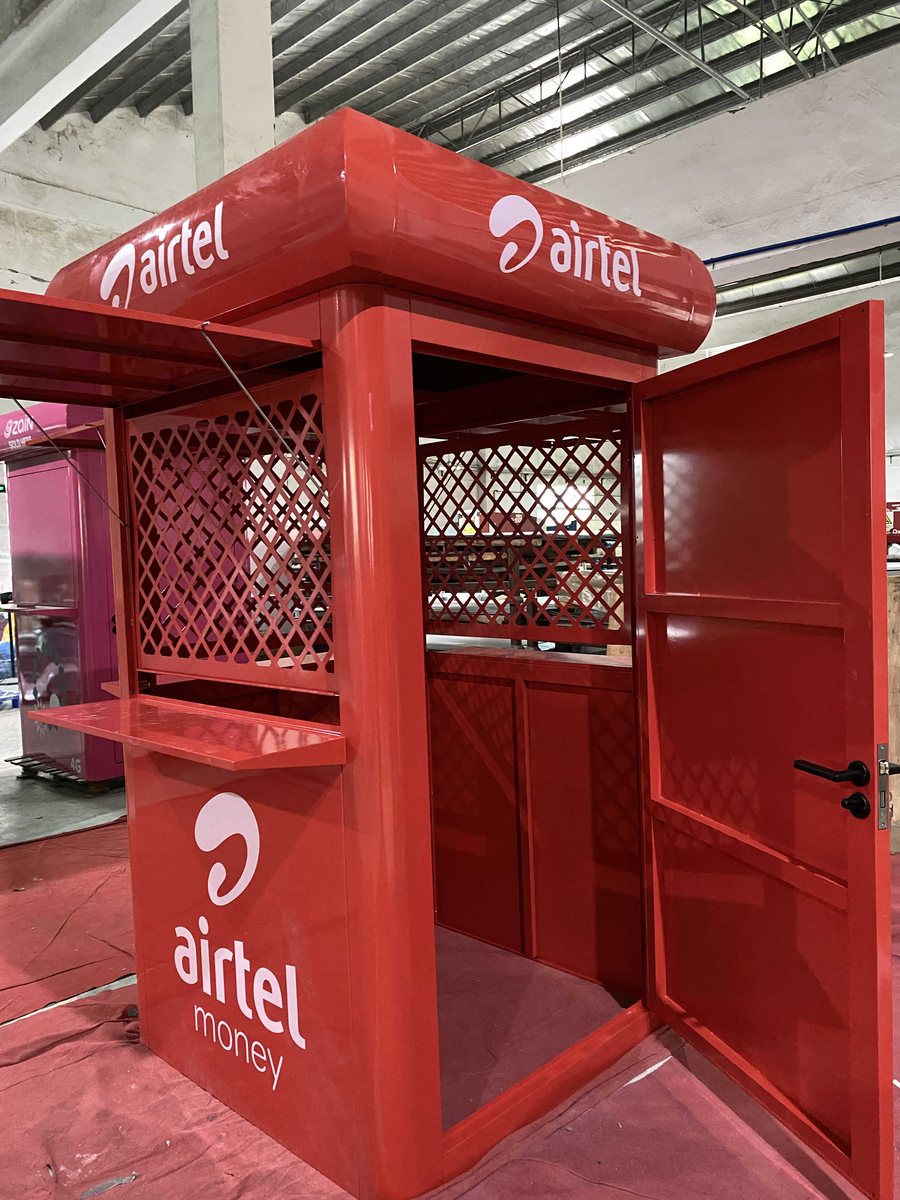
The pattern repeats across industries. Telecom and mobile-money operators need registration and top-up points near the customer. Cigarette and beverage brands need trade activation where the product is consumed. Lottery and betting operators need ticket sales at high-footfall locations. Retail and cosmetics brands need a branded presence in front of, or inside, someone else's store.
Different products, same requirement: a branded, staffed, movable point of presence. With more than a hundred designs in the range and fifty-plus projects delivered, the useful question is rarely whether a format exists — it is which format fits this site, this menu and this budget.
What we ask before proposing anything
Three questions usually determine the answer: where will it stand (indoor, outdoor, or both), how long will it stay (a weekend, a season, or open-ended), and who operates it (brand staff, an agent, or a partner's team). Everything else — size, materials, finishing, smart options — follows from those three.
If the answer to the second question is genuinely open-ended, we will say so: at that point a fixed kiosk is usually the better investment, and it is better to hear that before the tooling is committed.
Thinking about a pop-up channel?
Send us the site, the duration and who will run it. We will tell you which format fits, what it can carry, and where the cost actually sits.
Or email market@flowvisual.com. We reply within 24 hours on business days.