
Building a Branded Pop-Up Shop Network Without Fixed Retail Space
A branded terminal network used to mean leases, fit-out budgets and months of construction. A folding cart or a collapsible kiosk changes the arithmetic: the same unit can open, close and move on the same day.
Why a third retail channel exists
Most consumer brands in emerging markets sell through two channels: a fixed shop with a lease and a fit-out, or an e-commerce store with a warehouse and a courier contract. Both work. Both are also slow to open and expensive to close, which is a problem when a brand needs to be present in a market for six weeks, not six years.
That gap is where the branded pop-up shop sits. It is not a smaller version of a shop and it is not a market stall: it is a branded terminal — a counter, cart or kiosk that carries the brand identity, can be deployed where customers already are, and can be removed without leaving a lease behind.
- Lower entry cost than a fixed shop: no long lease, no permanent construction work, no shopfront.
- Faster to open and faster to close: the unit is transported assembled or in panels, then positioned and branded.
- Reusable: the same asset moves to the next site, the next city or the next campaign instead of being written off.
What a portable branded terminal actually is
The category is broader than the word “cart” suggests. Our range covers four formats that solve the same problem in different ways: a folding vending cart for street and event selling, a metal collapsible kiosk for sites that need a lockable enclosure, a folding display table or counter for indoor promotion, and a promotion trolley for sampling and demonstration work.
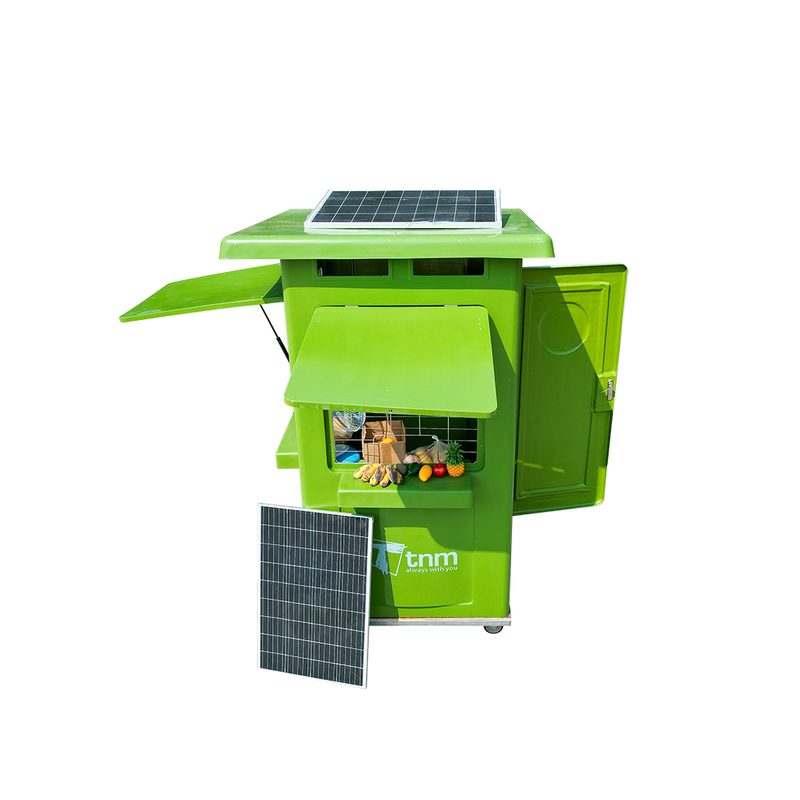
Two further families sit alongside them: a smart advertising screen for content-led activations, and a portable solar charging station for sites without a reliable power supply. In practice a network is usually a mix — kiosks on the high-traffic corners, carts for events, counters inside partner stores.
Five specifications that decide whether a network scales
Most failed rollouts fail on specification, not on design. These five points decide whether the twentieth unit is as usable as the first.
- Portability. Collapsible or folding structure, so a unit can be transported in a van, carried into a mall through a service entrance, and moved again next month without a crane.
- Branding method. Silk-screen printing for solid colours and repeat orders, digital UV printing for photographic artwork and short runs, vinyl stickers for campaigns that will change.
- Materials. Sheet metal, stainless steel, aluminium and injection-moulded plastic each solve a different problem — cost, corrosion, weight, or complex shapes. The mix matters more than any single choice.
- Site flexibility. The same unit should work indoors and outdoors, and should look intentional standing alone or grouped in a row of four.
- Optional smart layer. Solar power, wirelessly controlled LCD screens, GPS security and a Wi-Fi router can be added per site, not per model.
Where these units earn their place
The formats are used by telecom and mobile-money operators for SIM registration and top-ups, by cigarette and beverage brands for trade activation, and by lottery operators for ticket sales at high-footfall locations. Each has the same underlying requirement: a branded, staffed point of presence that can be placed close to the customer rather than waiting for the customer to come to a shop.
Inside shopping malls, operators often group several carts into a branded zone; on the street, a single unit with a generous advertising panel does the work of a billboard and a counter at the same time.
What to settle before the first order
A rollout brief is usually one page. It should answer these questions before tooling starts:
- How many sites, in how many cities, and in what order?
- For each site type: indoor or outdoor, power available or not, single unit or grouped?
- What must the unit carry — stock volume, a counter for two staff, a screen, a fridge?
- Which artwork surfaces will change per campaign, and which are permanent?
- Who maintains the units, and where do spare panels and printed skins live?
A rollout sequence that survives contact with reality
In practice networks are built in waves. A pilot of a few units proves the siting and the staffing model; the second wave standardises whatever the pilot changed; the third wave is where volume pricing and local assembly start to matter. Designing the unit to be shipped flat and assembled locally is often what makes wave three affordable.
The commercial value is not in the unit itself but in what it replaces: rent, renovation and transport costs that a fixed shop would carry every month. That is the number to put against the purchase price — not the price of a cart against the price of a table.
Planning a branded terminal rollout?
Send us the site list — indoor or outdoor, power or no power, single unit or grouped — and we will come back with the formats that fit, plus what the artwork and finishing would involve.
Or email market@flowvisual.com. We reply within 24 hours on business days.